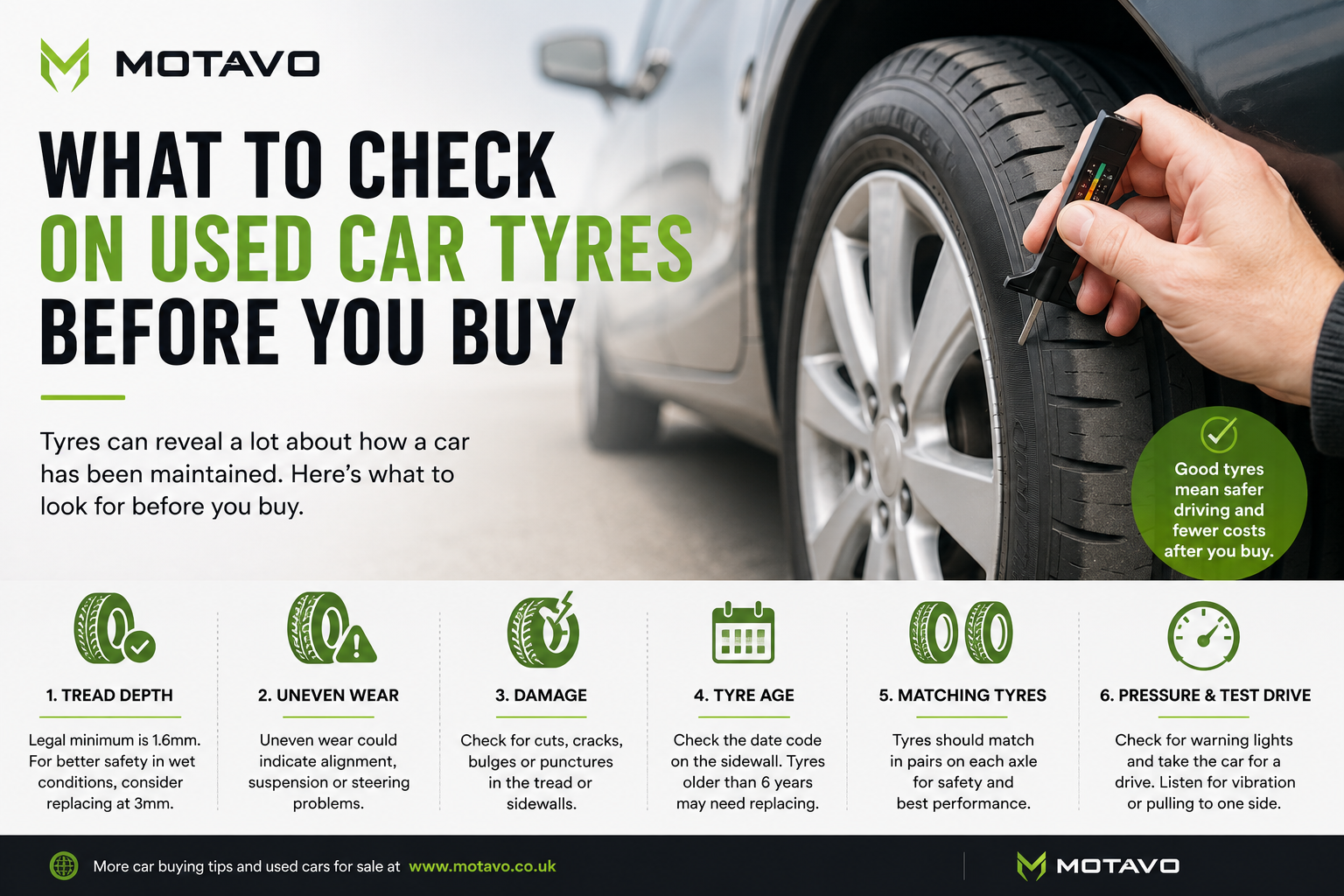
Why tyres matter when buying a used car
When buying a used car, tyres are easy to overlook. Most buyers focus on mileage, service history, paintwork, engine noise and price. But the tyres can tell you a lot about how the car has been maintained, how safely it has been driven and whether extra costs are waiting after purchase.
A car with four good tyres gives a better first impression. A car with worn, cracked, mismatched or uneven tyres may suggest poor maintenance, suspension issues or previous neglect.
Tyres are also a safety item. They are the only part of the car touching the road, so it is worth taking a few minutes to check them properly before agreeing to buy.
1. Check the tread depth
In the UK, the legal minimum tread depth for cars, light vans and light trailers is 1.6mm across the middle three-quarters of the tyre and around the entire circumference.
That is the legal limit, but many tyre safety organisations recommend considering replacement earlier, often around 3mm, especially if you regularly drive in wet conditions.
When viewing a used car, check all four tyres. Do not just look at the outside edge. Turn the steering wheel if needed so you can see more of the front tyre surface.
A simple tread depth gauge is best, but the 20p test can also help. Place a 20p coin into the main tread groove. If the outer band of the coin is visible, the tyre may be close to or below the legal limit and should be checked properly.
2. Look for uneven tyre wear
Uneven wear can be more important than low tread alone. If one edge of the tyre is much more worn than the other, it may point to tracking, wheel alignment, suspension or steering issues.
Common signs include:
- Heavy wear on the inside edge
- Heavy wear on the outside edge
- One tyre more worn than the others
- Patchy or wavy wear across the tread
- The car pulling to one side during the test drive
If you see uneven wear, budget for new tyres and a wheel alignment check. If the wear is severe, it may also be worth having the suspension inspected before buying.
3. Check for cracks, cuts and bulges
Walk around the car and inspect the tyre sidewalls. Look for cracks, cuts, splits, lumps or bulges. A bulge in the sidewall can be dangerous and usually means the tyre needs replacing.
Also check for nails, screws or signs of a slow puncture. A minor puncture in the central tread area may be repairable, but damage near the sidewall normally means replacement.
If a seller says “it only needs a bit of air”, be careful. A tyre that keeps losing pressure may have a puncture, damaged valve, cracked wheel or previous poor repair.
4. Check the tyre age
Tyres can look fine but still be old. Rubber hardens over time, which can affect grip and safety. This matters especially on low-mileage cars, weekend cars, convertibles, older vehicles and cars that have been parked for long periods.
You can check the tyre age by looking for the four-digit date code on the sidewall. For example, a code of 2421 means the tyre was made in week 24 of 2021.
If the tyres are very old, cracked or perished, treat them as a likely replacement cost even if the tread still looks acceptable.
5. Are the tyres matching?
Ideally, tyres should match in pairs across the same axle. For example, the two front tyres should be the same brand, size, speed rating and similar tread depth.
A car with four different budget tyres is not automatically a bad car, but it can suggest the previous owner replaced tyres as cheaply as possible. On performance cars, SUVs and electric cars, tyre quality and correct specification matter even more.
Also check that the tyre size matches what the car should have. The tyre size is printed on the sidewall, for example 205/55 R16. If the car has unusual wheel sizes, replacement tyres may be more expensive.
6. Check the spare wheel or repair kit
Many modern cars no longer come with a spare wheel. Instead, they may have a tyre repair kit or inflator. Check what the car should have and make sure it is present.
If the car has a spare wheel, check the condition and tread depth. A flat, cracked or missing spare wheel is another cost to consider.
7. Watch for tyre pressure warning lights
If the car has a tyre pressure monitoring system, check there are no warning lights on the dashboard. A warning light may simply mean low pressure, but it can also point to a damaged sensor, puncture or system fault.
During the test drive, listen for tyre noise, vibration through the steering wheel or the car pulling to one side. These can all suggest tyre, wheel balancing, alignment or suspension issues.
Estimated tyre-related costs in 2026
Costs depend on tyre size, brand, vehicle type and location. As a rough UK guide in 2026:
| Item | Estimated cost |
|---|---|
| Budget tyre | £45 to £70 per tyre |
| Mid-range tyre | £75 to £120 per tyre |
| Premium tyre | £220+ per tyre, depending on size and model |
| Wheel balancing | Around £10 per wheel |
| Puncture repair | Around £30 to £50 per tyre |
| Front wheel alignment | Around £30 to £50 |
| Four-wheel alignment | Around £60 to £90 |
If a used car needs four tyres, the real cost can quickly add up. Even on a small hatchback, four decent tyres, balancing and alignment can make a cheap car less of a bargain.
Use tyres as part of the negotiation
If the tyres are close to the legal limit, mismatched, old or damaged, use that information when discussing the price. Be fair, but realistic.
For example, if a car needs two front tyres and alignment, you may need to budget £180 to £300 or more depending on the vehicle. If it needs four tyres on a larger SUV or performance car, the cost can be much higher.
Quick tyre checklist before buying
- Check tread depth on all four tyres
- Look for uneven wear on inner and outer edges
- Check sidewalls for cracks, cuts and bulges
- Check tyre age using the date code
- Make sure tyres match in pairs on each axle
- Check tyre size and speed rating
- Look for nails, screws or signs of slow punctures
- Check spare wheel or repair kit
- Look for tyre pressure warning lights
- Listen for vibration, pulling or road noise on the test drive
Final advice
Tyres are one of the simplest things to check on a used car, but they can reveal a lot. Good tyres suggest the owner has cared for the car. Poor tyres may suggest hidden costs or wider maintenance issues.
Before buying, take your time, check each tyre properly and factor any replacement costs into your offer. A car with fresh, matching, good-quality tyres can be worth paying a little more for, especially if everything else checks out.
You can browse used cars and compare available listings at Motavo.co.uk.